

This post dates to the time I was working with Balaji Telefilms as writer on Sony’s Bade Acche Lagte Hain—Season one (starring Sakshi Tanwar and Ram Kapoor) to be precise.
No Balaji experience would be complete without the legendary late-night meetings with Ekta Kapoor. When creative meetings ran overtime, they often stretched into the night, or even the early hours of the morning. These later meetings would then be shifted from the Balaji Headquarters to Krishna—Jeetendra’s palatial bungalow in Juhu.
Five or six of us writers would land at the home, usually a little dazed from the day. My favorite part was always hanging out in the waiting area. It was lined with Jeetendra’s trophies and silver jubilee mementos from films like Himmatwala and Tohfa. If you sat there long enough, it started to feel like you were waiting inside a piece of film history.
Once Ekta wrapped up the meeting before ours, we would be called in to discuss Bade Acche Lagte Hain. We’d walk past a grand, twirling, staircase and crystal chandeliers into a marble-floored living room that reminded me of the fictional homes I had seen on television. No wonder Balaji’s serial sets were always so grand—the inspiration was right at home.
Tea and coffee were available, of course. But the real MVP was the buttermilk. Mitu, our creative head and one of Balaji’s original pillars, always requested chili cheese toast from the house staff—something I started looking forward to at every meeting. I also recall eating a rather delicious corn-chat snack during my first visit, but let’s get back to the main subject of this post.
The Bungalow Before The Boom…
Fun fact: Balaji’s first office wasn’t Balaji House—it was the garage of Krishna Bungalow!
Before their present headquarters, before the scale and domination, Balaji operated out of the basement of this very bungalow. For six years, the team worked out of the basement; writing, ideating, and producing shows that were slowly finding their audience.
If you go back and watch early Balaji shows, you can actually spot the bungalow. The exterior often doubled up as homes of wealthy families, and parts of the interiors were used within scenes as well. Priya Tendulkar appears from a photo frame as the deceased mother in Hum Paanch. Smriti Irani is seen praying to the tulsi plant in Kyunki Saas Bhi Kabhi Bahu Thi. And several moments from Mano Ya Na Mano were shot on the street right outside the main gate. 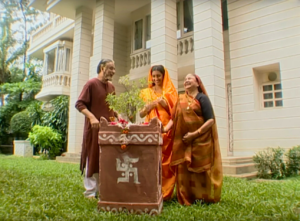
A snapshot from Kyunki Saas Bhi Kabhi Thi – Smriti Irani worships the tulsi plant in the garden of Krishna Bungalow.
Image Courtesy: Disney + HotStar
Many actors from that era gave their first auditions in this very basement. Jayati Bhatia, Bhairavi Raichura, Vandana Pathak and Rakhi Vijan, to name a few.
I remember Smita Bansal once telling me about her own experience. She’d come with her mother to audition for Itihaas, and at some point, they caught a glimpse of Jeetendra. They were completely starstruck. Her mother joked that the trip had already been worth it. Even if Smita didn’t bag the role, that moment alone was enough.
At the time, Krishna Bungalow was just another location. In retrospect, it feels like a quiet origin story hiding in plain sight.
Basement to Break-Through…
I had the privilege of having a lengthy heart-to-heart with Shobha ji (Shobha Kapoor) while doing research for my book, Kingdom of the Soap Queen: The Story of Balaji Telefilms. Trust me, I didn’t just walk into that meeting; she made me eat prasad first. She shared with me some stories that are too good to not share here.
In the late ‘90s, Balaji was bursting at the seams. The small basement was where they produced serials that were growing in number and popularity. Outsourcing shooting locations wasn’t the most efficient way to do things, and rents were skyrocketing. They’d tasted success no doubt – Hum Paanch, Itihaas, Kanyadaan and Koshish…Ek Aasha being a few examples. But the big boom was yet to come. Enough profit was rolling in to create new shows, but not as much as needed to expand the business.
The Kapoors consulted their astrologer, who told them something simple. If Balaji continued operating out of that basement, it would not grow. Working from beneath the Earth would sustain the business, but would not nurture it. Much like a plant, they needed to move above the earth, into a space with light and visibility.
At the time, it sounded like a metaphor. In hindsight, it reads like strategy.
Shobha ji approached the situation with her entrepreneurial hat – using one problem to solve another.
In 1994, Jeetendra, along with the Sri Adhikari Brothers, had purchased a plot in Andheri West to build an office. A year later, the real estate market crashed. The Adhikaris pulled out, leaving behind a half-built structure and no clear way to finish it. By 1999, Shobha ji secured a substantial loan, resuming construction.
In 2000, Balaji House was finally completed. For the first time, the company had dedicated floors to writing, editing, accounts, and even in-house sets for filming. The first floor was used for Shobha and Ekta’s cabins accompanied with space for creative heads and writers. The second floor was Jeetendra’s cabin and accounts, while the third floor housed editing studios. The basement, ground, fourth and fifth floors, meanwhile, were converted into sets for shooting.

Balaji House, Andheri West – featured in many serials of that era.
Kyunki, Miracles Happen…
What happened next feels almost unreal.
Five days after the move, on January 19, Balaji signed a deal with Star Plus for a show called Amma. And let me tell you, this wasn’t just any show; it was the one that changed everything. The show- which was later renamed Kyunki Saas Bhi Kabhi Bahu Thi, turned Balaji’s fortunes upside down and went on to revolutionize Indian television.
Soon after came Kahaani Ghar Ghar Kii, and with that, Balaji became the go-to name for Hindi television. Advertisers followed, channels followed, and the company found itself producing hit after hit.
Looking back, the journey feels less like a straight climb and more like a series of decisions taken under pressure. A basement that could no longer hold the ambition. A half-built structure that refused to be abandoned. A move that had to work.
The message here is not just about making it big in business; it’s about resilience.
That meeting with Shobha ji still stays with me. Not just for the stories, but for how it began. Sometimes, you need a little prasad, some good advice, and a whole lot of hard work to push through the impossible.
Well that’s all folks! Until the next soap opera saga, keep that Bollywood magic alive!